CERG: Simulation Results
Contact-friendly reference governor, validated in simulation. RSS 2025 HRCM Workshop
Presented at the Workshop on Human-Robot Contact and Manipulation (HRCM), Robotics: Science and Systems (RSS) 2025. Read the abstract here. The full paper, with hardware experiments, is on the IFAC 2026 page.
Y. Gautam, N. Nechyporenko, C.-H. Lin, A. Roncone, M. M. Nicotra. “Compliant Explicit Reference Governor for Contact.”
Background: the Explicit Reference Governor
The Explicit Reference Governor (ERG) is an optimization-free way to enforce constraints on complex systems such as robots (Nicotra & Garone, 2018), (Merckaert et al., 2022). Instead of changing the controller, it changes the reference. Given a desired reference \(r\), the ERG produces an auxiliary reference \(v\) such that the system \(\dot x = f(x,u)\) satisfies its constraints at all times, while \(\lim_{t \to \infty} v(t) = r\) whenever \(r\) is admissible. The auxiliary reference evolves according to a navigation field \(\rho(v,r)\) scaled by a dynamic safety margin \(\Delta(v,x)\):
\[\dot v = \rho (v,r)\, \Delta (v, x)\]and is applied to a prestabilized system, for example
\[u = -K_P(x-v)-K_D\dot x.\]The ERG is computationally cheap (Merckaert et al., 2024), but it treats every constraint the same way: as something that must never be violated. That rules out contact entirely, which is a problem for tasks like wiping, pushing, or clearing a cluttered shelf.
The Compliant ERG
The Compliant Explicit Reference Governor (CERG) distinguishes between two kinds of constraints:
- Hard constraints can never be violated: joint limits, velocity and torque limits, actuator saturation, forbidden surfaces.
- Soft constraints may be violated, meaning the robot may touch them, as long as the interaction is safe.
Safety during contact is defined through a maximum energy \(E_{\max}\), which for simple systems maps directly to a maximum contact force. CERG guarantees that soft constraints are violated only when necessary and only within the energy bound, while hard constraints are never violated. In free motion, the energy bound is inactive, so the robot is not slowed down when nothing is in the way.
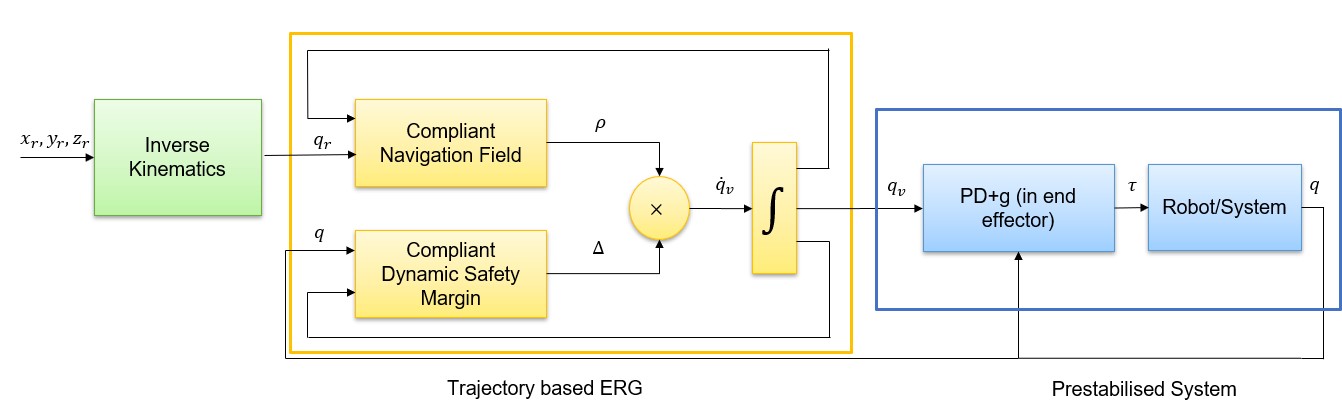
The structure is the same as the ERG, but both the navigation field and the dynamic safety margin are split into soft and hard components, \(\rho_s(v,r), \rho_h(v,r)\) and \(\Delta_s(v,x), \Delta_h(v,x)\). The soft repulsion term lets the auxiliary reference penetrate a soft constraint up to a depth set by the penetration constant \(\delta_s\), which in turn sets how hard the robot pushes at steady state. The compliant dynamic safety margin is built so that either no constraint is violated or only soft constraints are violated within the energy bound.
Two-Link Robot Manipulator
The two-link (RR) manipulator model follows (Lynch & Park, 2017). We prestabilize it in the end-effector frame:
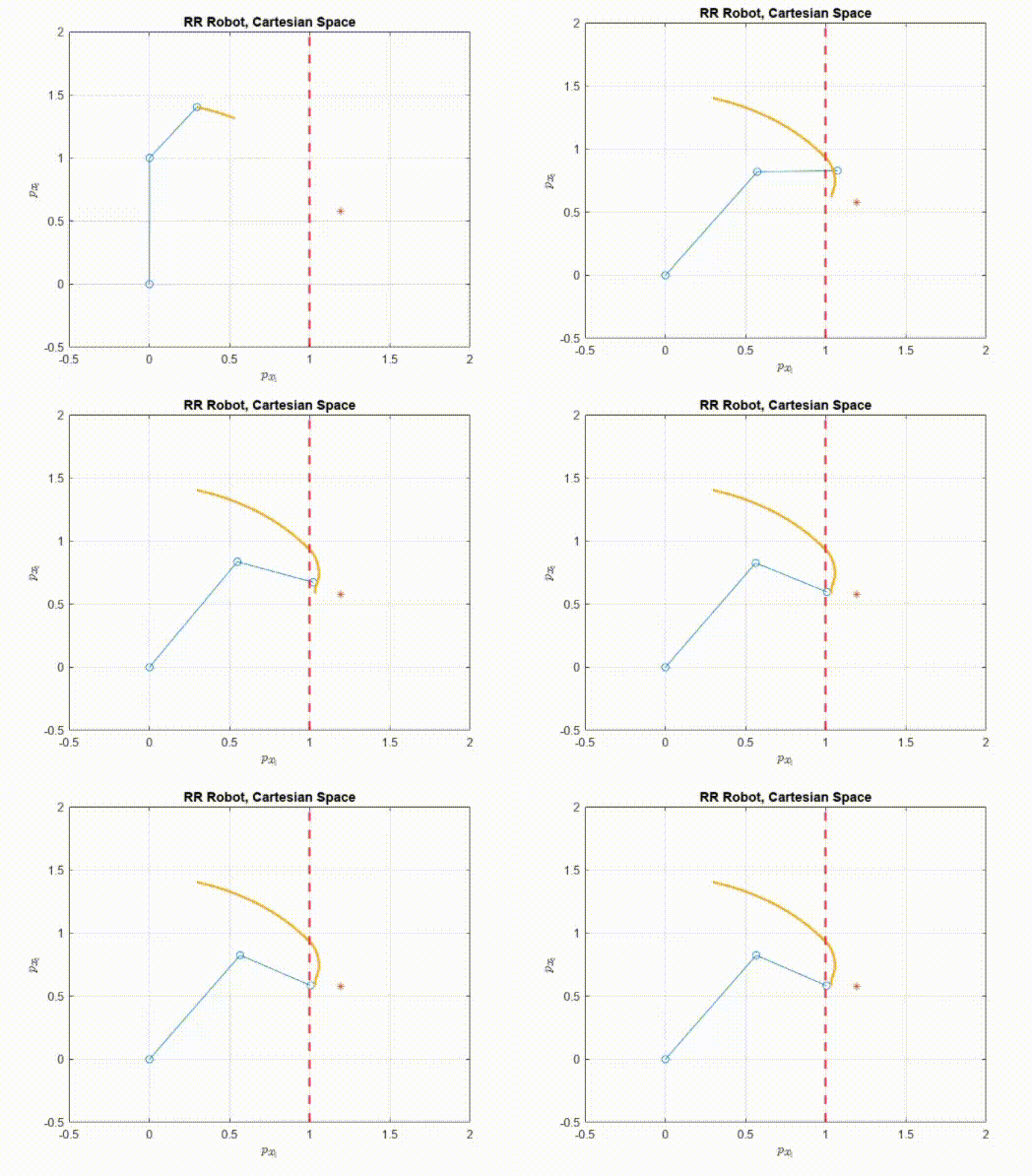
\[u = -K_P J(q)^\top (f(q) - f(v)) - K_D\dot q + g(q),\]with \(K_P = 16I_2\) and \(K_D = 10I_2\). The reference \(r\) is placed beyond a soft wall. Controlling in end-effector space lets the end effector get as close to the reference as the wall allows while staying under \(E_{\max}\). The paper also discusses the joint-space alternative, which is better suited to hierarchical architectures.
Effect of the penetration constant
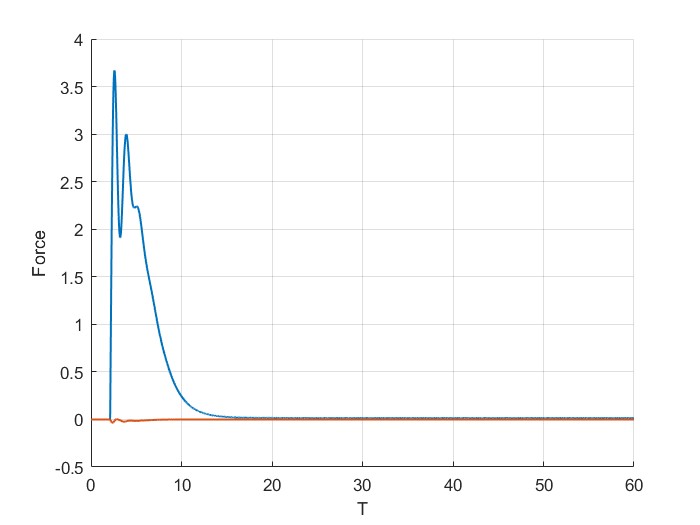
With a small penetration constant, \(\delta_s = 0.1F_{\max}/K_P\), the reference barely enters the soft constraint. The end effector slides along the wall and pushes gently.
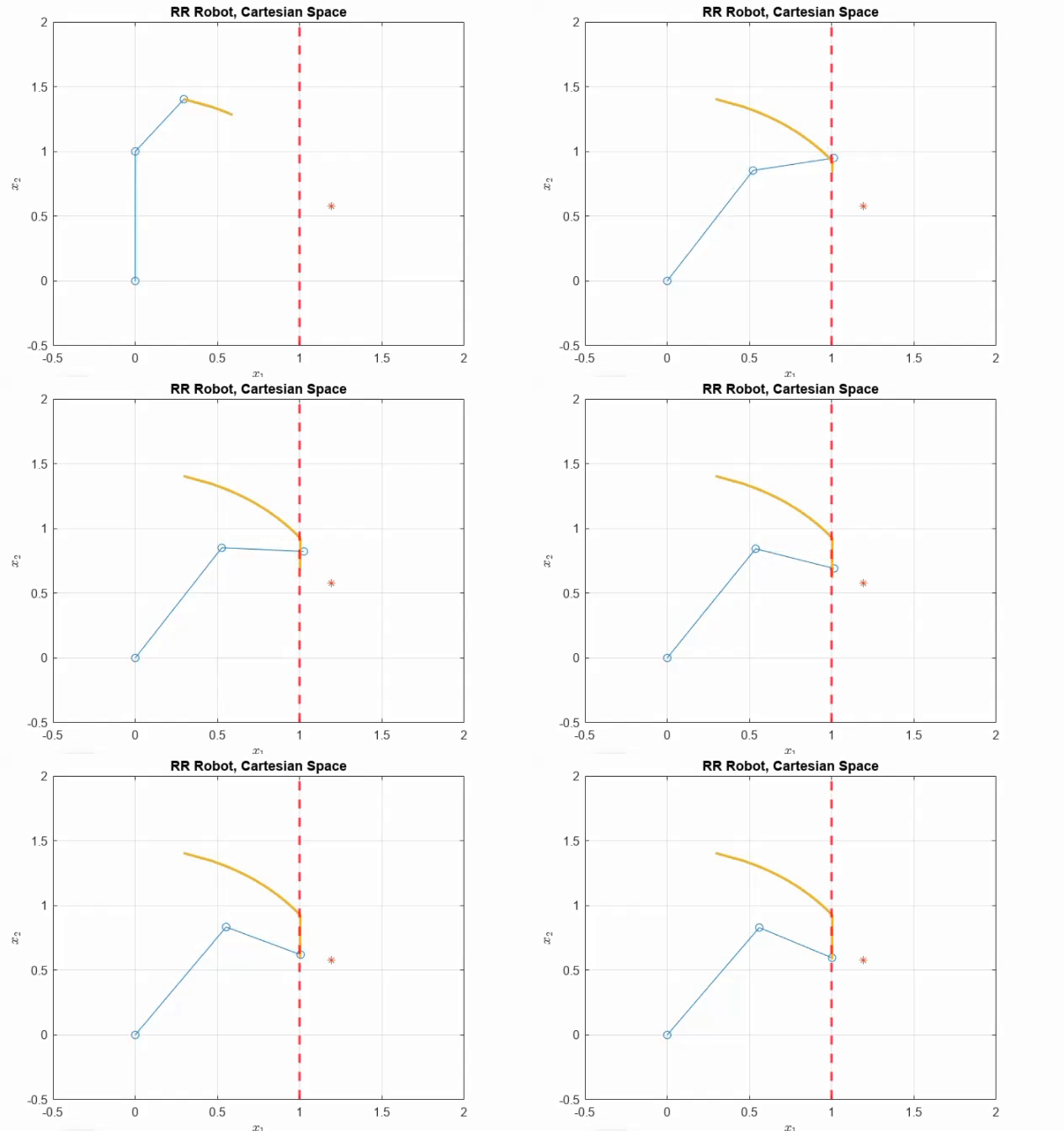
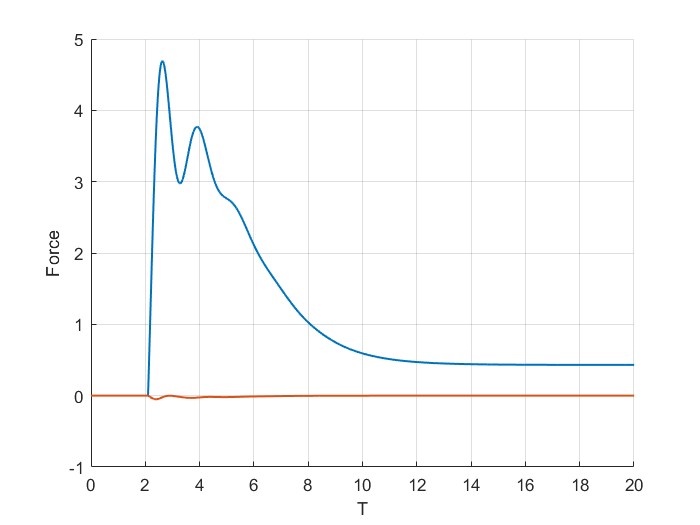
With a large penetration constant, \(\delta_s = 0.9F_{\max}/K_P\), the end effector enters the soft constraint further and pushes harder, converging to a nonzero steady-state force.
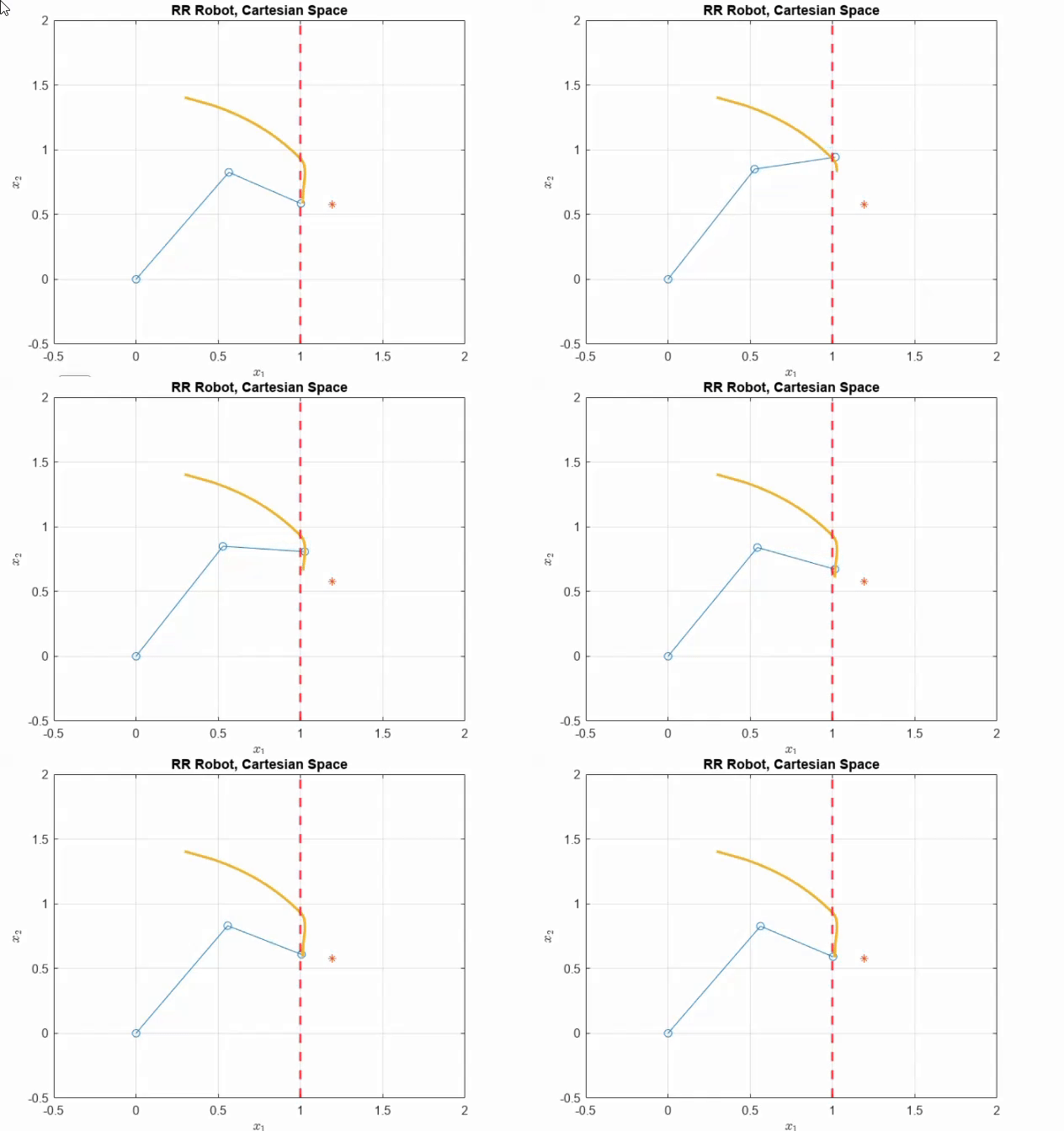
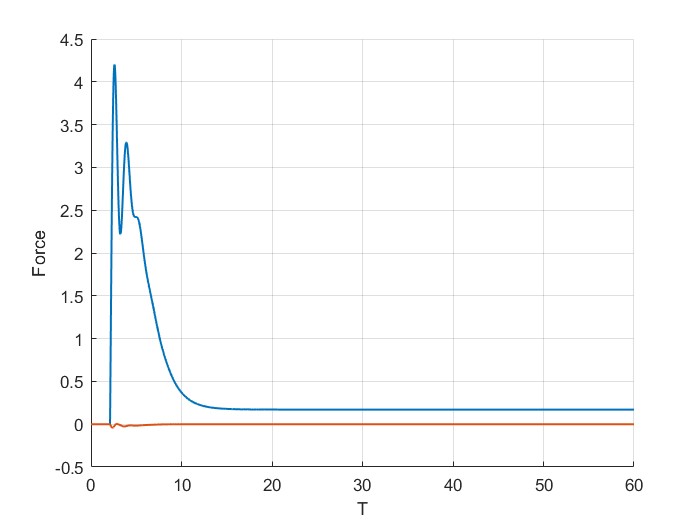
In both cases the contact force stays below \(F_{\max}\), which is set by \(E_{\max}\). The penetration constant tunes how much the robot pushes; the energy bound guarantees it never pushes too hard.
Franka Emika in Drake
Finally, we test CERG on a 7-DoF Franka Emika in the Drake simulator with a compliant point-contact model. The robot is subject to its real actuator, velocity and torque limits (Franka specifications), and the reference sits inside the soft blue wall.
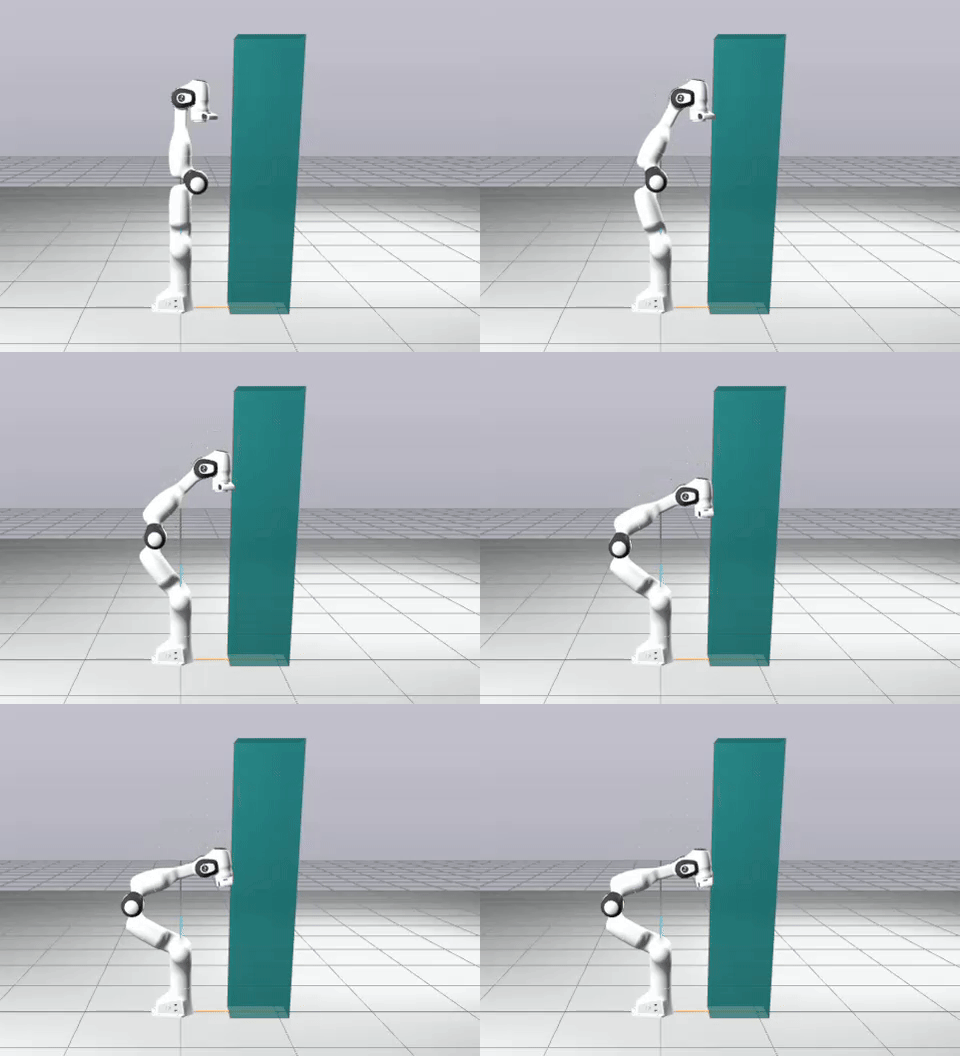
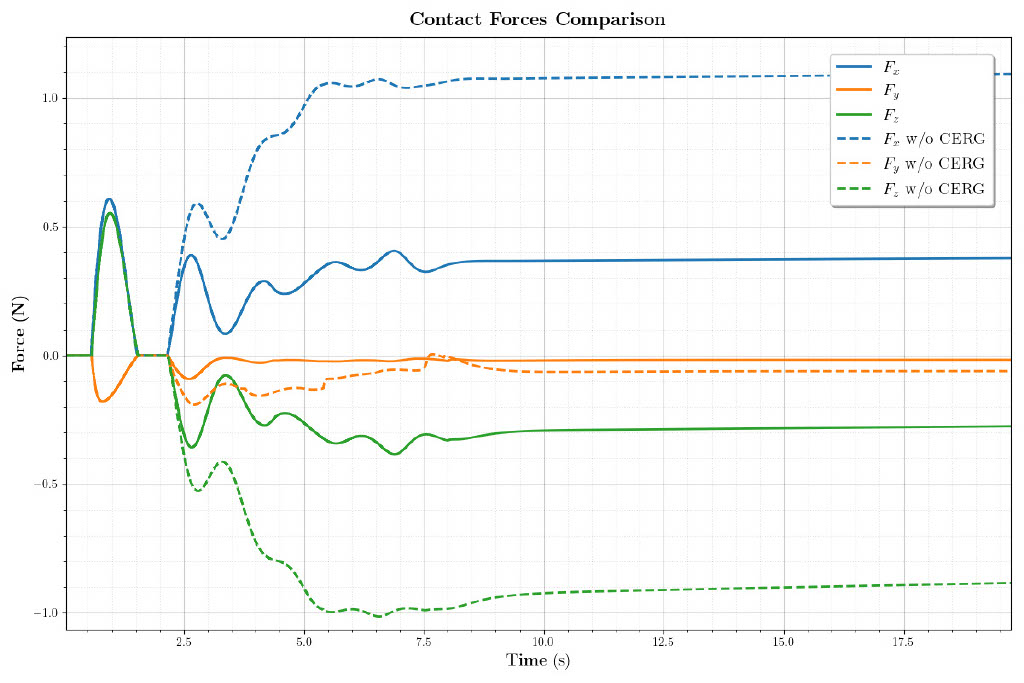
Without CERG, the contact forces are significantly higher. With CERG, the robot moves at full speed in free space and keeps its energy below \(E_{\max}\) once it is in contact, so it slides along the wall without damaging itself or the obstacle.
For what happens on a real robot, see the IFAC 2026 page.
References
2024
- Real-time constraint-based planning and control of robotic manipulators for safe human–robot collaborationRobotics and Computer-Integrated Manufacturing, 2024
2022
- Real-time motion control of robotic manipulators for safe human–robot coexistenceRobotics and Computer-Integrated Manufacturing, 2022
2018
- The Explicit Reference Governor: A General Framework for the Closed-Form Control of Constrained Nonlinear SystemsIEEE Control Systems Magazine, 2018
2017
- Modern robotics2017